
For thirty years I cooked by the clock. Thirteen minutes on the timer, a knife nick into the thickest part of the chicken, and a hope that it looked done. Some nights I won that gamble, and on the nights I lost I carved shoe leather and reached for the gravy. Then a buddy who flies cargo for a living said something that changed the routine for good: you do not fly a cross-country by estimating where you are, you fly the gauges. Meat is exactly the same animal. Cook by temperature instead of by time and dinner stops being a coin flip. You just need a thermometer that reads fast enough to keep up with a steak that is already searing.
That thermometer, for two years now, has been the TempPro TP19H. It reads in about one second, wakes the instant you pick it up, and it costs less than a decent steak, so there is no real downside to owning one. It lives in the drawer by the stove and it has quietly retired every timer and every poke test I ever used. One honest note before the steps: the thermometer does not cook the meat. You still have to take it off the fire at the right moment. What it does is settle the one decision that decides dinner, and it settles it with a number instead of a guess.
The whole routine takes about thirty seconds a cook once the numbers are taped inside the cabinet door. Heat the pan, cook the protein, probe it in the right spot at the right moment, pull it at the right number, rest it. Five steps, no kitchen maths, no chef talk. It works on a Tuesday pork chop exactly the way it works on a holiday turkey, and it does not ask you to change how you cook, only how you check it.
The Probe This Whole Routine Runs On
The TempPro TP19H wakes the moment you pick it up and reads in about a second, which is the entire skill of cooking meat to temperature. One tool, one number, no guesswork. Today's price makes the decision easy.
Amazon Check Today's Price on Amazon →Step 1: Get an Instant-Read Thermometer, Not Another Timer
Timers fail because every cut of meat cooks at its own pace. A four-pound chuck roast and a two-pound chuck roast on the same oven rack can be twenty minutes apart at the same setting, and nothing on the package tells you which one you are holding. The poke test fails for a different reason: comparing your thumb web to the middle of a roast reads the muscle in your hand, not the muscle under the heat. Both of those old tools measure the cook, not the food. A thermometer measures the food, and that is the entire upgrade.
Buy the probe once, so buy it right. Look for three things. Speed first: the reading should settle in two or three seconds, because a steak on a hot pan climbs a degree every few seconds while you wait. The TempPro TP19H advertises a one-second read. In practice I count about two before the number steadies, which is more than fast enough for anything I cook. Second, ease of use: the motion-wake is not a gimmick. You grab the unit and it is already reading, with no button to search for in the dark beside a grill. Third, a backlit display and a thin, sturdy stem, because half of all temperature checks happen at dusk over a fire.
One thing the listings do not tell you, and it matters. Cheap instant-reads can be accurate at room temperature and drift at searing heat, so expect to distrust the first reading of a brand you have never used. Do not chase the hundred-dollar lab units unless you must win a competition. They are better, but for a home cook the gap mostly shows up in temperature ranges you will rarely visit. This TempPro is the same probe that sold for years as the ThermoPro TP19H, the company rebranded the line, and its 55,000-plus reviews were earned before and after the name change. At today's price it is the easiest recommendation I make in this kitchen.
Step 2: Write Down the Target Numbers Before Anything Touches the Pan
Everything in this step is either a USDA safety line or a finish number I have confirmed by poking real dinners on this counter for two years. Write them down once, tape the list inside the cabinet door beside the stove, and you never think about them again. The same numbers serve every cooking method in the book: direct heat, reverse sear, sous vide, slow oven. Only the approach speed changes. The target never does. If a recipe gives you a time and a temperature, keep the temperature and treat the time as a hint.
Chicken and turkey: 165 in the thigh, with the breast at 160 to 165. That line is the safety number and it is not negotiable. Pork: 145, and do not flinch at the pink, that is normal and correct now. Beef steak: 125 rare, 130 to 135 medium-rare, 140 to 145 medium, 150 medium-well, and if you like yours at 160, I judge no one. Beef roast: pull at 130 to 135 for medium-rare, because carryover finishes the climb. Lamb: 130 to 135, the same numbers as beef. Fish: 140 to 145, and it should just flake when it gets there. Ground beef and ground turkey: 160 and 165, because grinding moves surface bacteria into the middle. Leftovers you are reheating: 165.
That is the whole list and it fits on a postcard. The most common mistake is treating every cut like a steak. A pork shoulder cooked to 145 comes out rubbery, and a chicken breast cooked to 165 as a minimum guarantees a bird that never lets the thigh get there. The numbers are per-cut for a reason, which is the whole point of writing them down. One tip that costs nothing: pull a thick steak out of the fridge thirty minutes before it hits the pan. A cold center widens the gap between done and overdone while the outside sears, and you end up with a wall of gray instead of a gradient of pink.
Step 3: Probe in the Thickest Part, Away From Bone and Fat
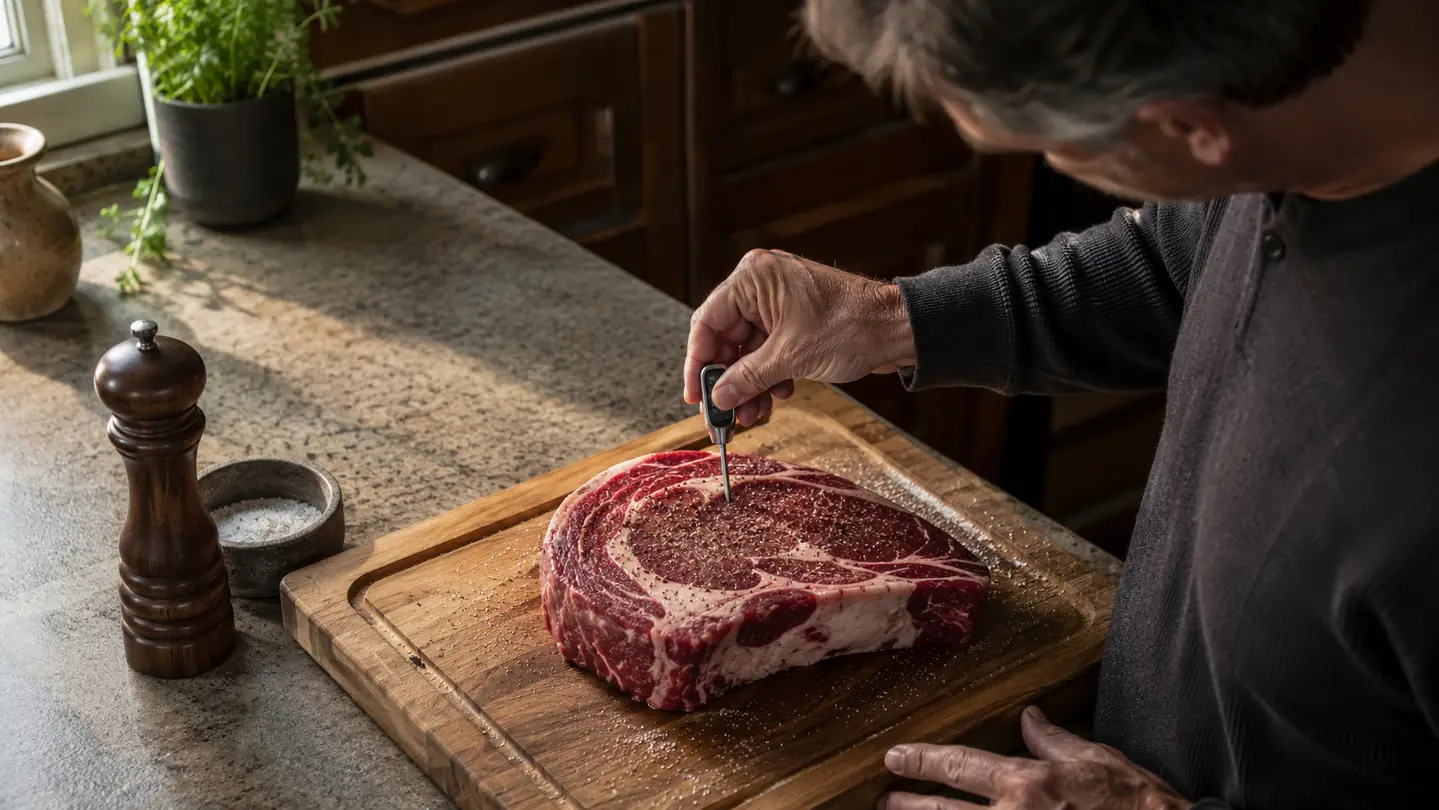
Where you insert the probe matters as much as the number it gives you. Go through the side of the cut into the center of the thickest section, and keep the tip out of bone and fat. Bone conducts heat differently than muscle, so a probe resting against one reads hot and pulls you off the fire early. Fat reads cool, which keeps you on the fire too long. You want the tip sitting in the middle of the densest muscle, and nothing else.
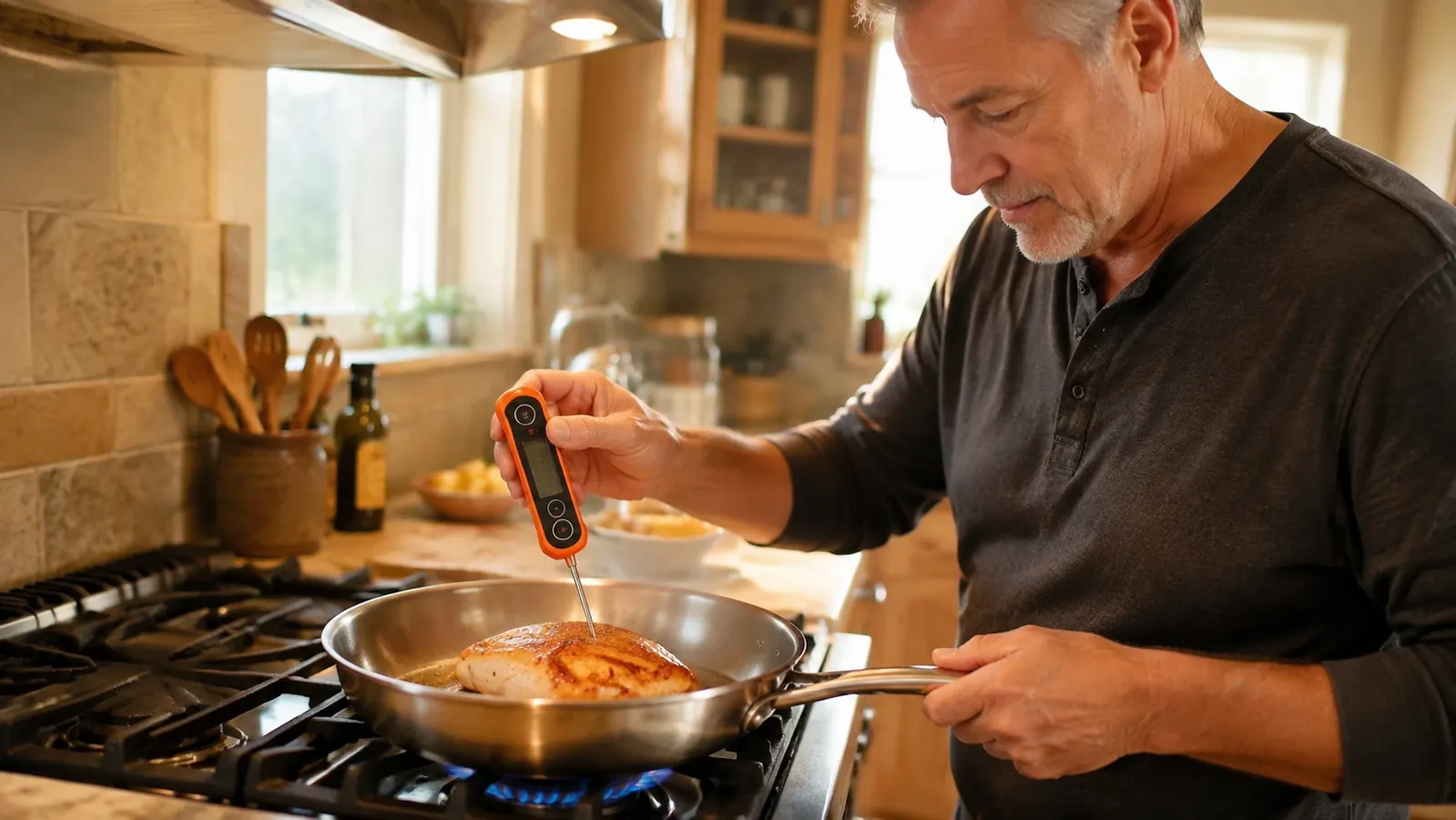
For poultry, take the reading in the thigh, not the breast. The thigh is the last part to come up to temperature, so when the thigh reads 165 the breast is already safe, and that is the whole point. For a roast, probe two or three spots before you call it done, because the center of a big roast is never uniform. For a steak, come in through the flat side and let the tip rest in the middle of the muscle, away from the pan. For a thin piece like a pork chop, angle the probe shallow so the tip stays in the meat and you read the meat, not the skillet underneath it.
Step 4: Pull It Early and Let Carryover Finish the Job
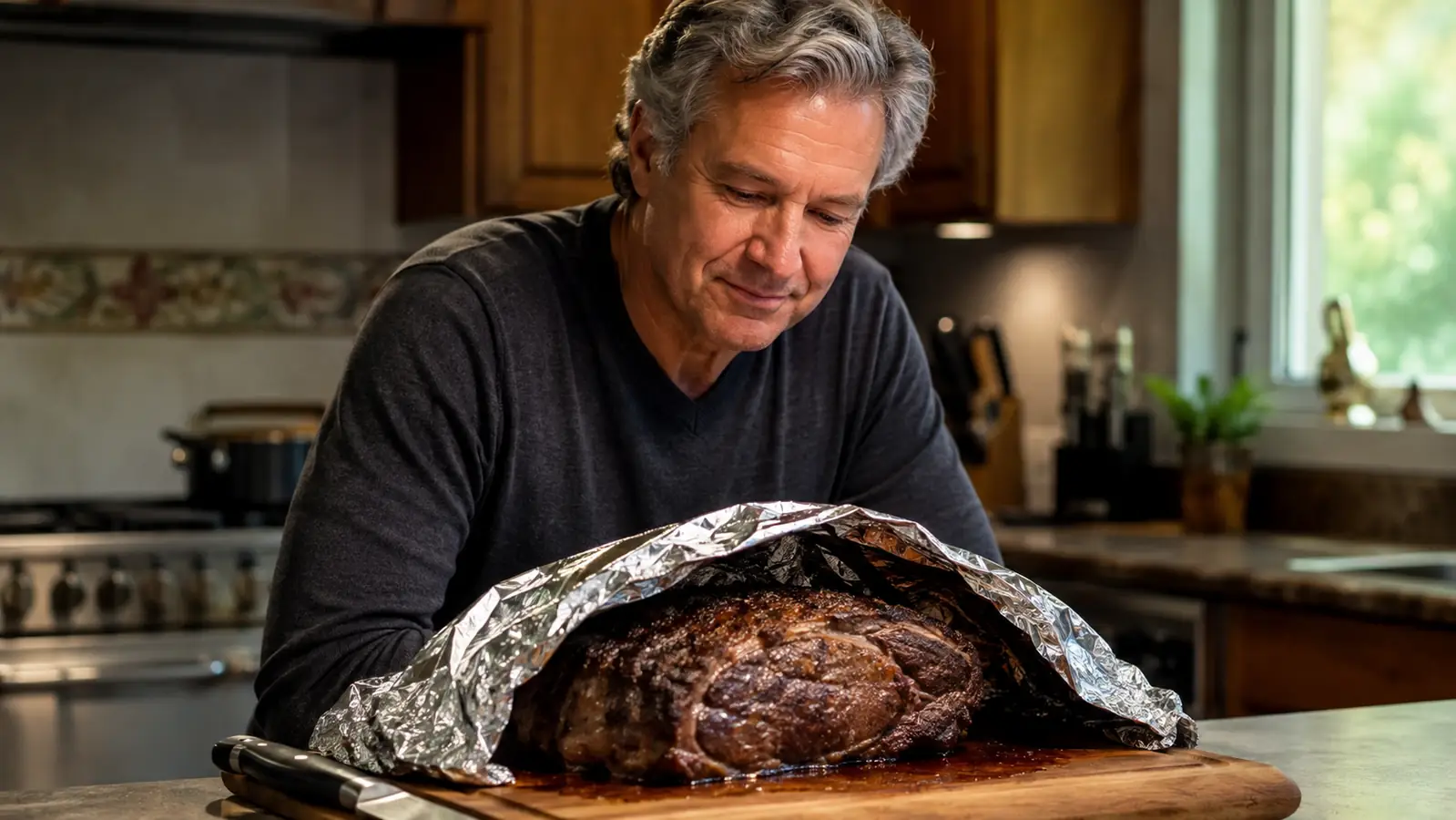
Here is the fact that saves more roasts than the thermometer itself. Meat keeps cooking after it leaves the fire. A large roast carries over five to ten degrees while it rests, and a steak carries three to five. That is why the pull number and the done number are two different numbers. Pull a beef roast at 132 and it climbs to 138 under the foil while you mash the potatoes. Pull chicken at 160 and it settles at 165 while you find the carving knife. This is not a trick, it is physics, and once you plan for the climb, medium-rare stops being luck.
Plan the climb in. Pull a roast about five degrees under your target, thick fish about ten under, then park it on the board. Rest anything big under a loose foil tent for at least ten minutes, and about half the total cook time for something the size of a turkey. The probe keeps climbing, then plateaus, then the juices pull back into the grain. Carve an unrested roast and every number you hit chases the juice across the cutting board. Same as a car: you do not torque the wheels and belt straight onto the track, you let it settle first. Meat is the same animal.
Step 5: Trust the Reading, and Verify the Tool Once a Season
The hardest part of this routine is not the probe, it is your own instincts. Every instinct I built over decades says a pork chop at 145 is raw. It is not. A whole chicken at 165 in the thigh is cooked even if the leg joint still shows pink, and that pink is fine and safe. The number is the truth. The instinct is the habit left over from before the food-safety numbers came down. Cook to the reading and the dry-meat era ends, for chicken, for pork, for every roast you were too scared to pull early. The first three times you will second-guess the display. Push through it.
Two habits keep the numbers honest. First, treat the probe like any other utensil. Wipe it clean between raw and cooked meat, wash it in warm soapy water after the cook, dry the stem, put it back in the drawer. Second, check the calibration once a season in ice water, where it should read 32 degrees. The TempPro has held calibration for me across two years and a couple of accidental drops, but ten seconds of checking in January beats discovering on Thanksgiving that your bird was reading five degrees off in the wrong direction.
What Else Helps
A good instant-read is the one tool this routine cannot work without. Four cheap extras make it easier, in rough order of value. A leave-in probe thermometer with a remote readout, if you cook slow and low, lets you watch an overnight brisket climb without opening the firebox. A wire rack to rest meat on keeps the bottom of a roast out of its own juices so it stays crisp instead of soggy. A printed copy of the step-2 numbers taped inside the cabinet door is, embarrassingly, the highest-value item on this list. And a small digital scale makes your portions consistent, which makes your cook times consistent to begin with.
Notice what none of those do. None of them cook the meat for you. The combined cost of all four is less than one ruined roast, and the thermometer is still the part that matters.
One warning about the extras. Amazon will happily sell you a nine-piece thermometer station with a magnetic dock and a companion app. You do not need a dock. You need a probe that fits in the drawer and reads in about a second. Keep it simple. It is a one-job tool and the TempPro does that one job as well as anything on the shelf.
Pull the roast at 132 and it climbs to 138 under the foil while it rests. That carryover is free accuracy, and it is the difference between medium-rare and sawdust.
Tape the Numbers to the Cabinet Door, Then Buy the Probe
The TempPro TP19H is the thermometer this guide is built on. Motion wake, about a one-second read, and more than fifty-five thousand reviews behind it. Cook to the number, rest it, and overcooked meat stops being part of your week.
Amazon Check Today's Price on Amazon →