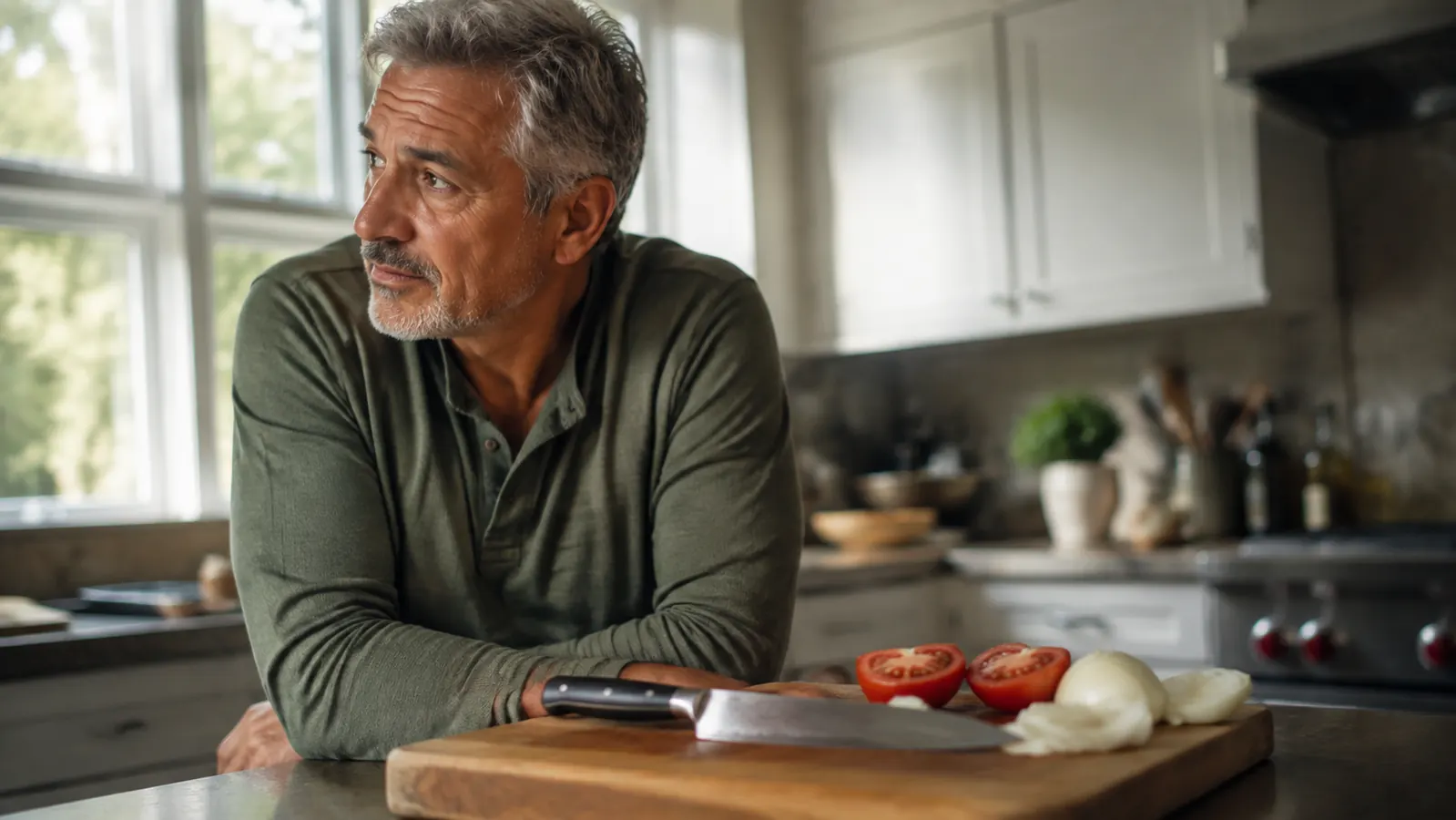
I owned a cheap stamped knife for years, then a Victorinox Fibrox, and now a Wüsthof Classic 8-inch that has lived in my knife roll for two and a half years. If you are trying to decide between the two knives in this title, here is the honest version in one breath: both are good knives, and they are not competing for the same cook. The Victorinox will get almost every dinner on the table for a fraction of today's Wüsthof price. The Wüsthof will outlast it, hold an edge longer, and it is the one I reach for when I actually want to cook instead of just make dinner.
The short answer, so you can stop here if you want: buy the Victorinox if you want a genuinely good knife and want to keep a big share of the price difference. Buy the Wüsthof Classic if you want one serious knife and plan to hand it to your grandkid. If that settles it, the table below gives you the whole argument in one place. If you want the why behind it, keep reading, because the real story is in the tradeoffs, and both of these knives have them.
The Spec Sheet: Wüsthof Classic vs Victorinox Fibrox
| Wüsthof Classic 8" | Victorinox Fibrox 8" | |
|---|---|---|
| Price | A real premium, and it earns it across decades of use | A fraction of the cost, and often on sale |
| Blade construction | Forged from one bar of steel, full tang | Stamped from a sheet of steel |
| Weight | About 8.5 oz; the blade carries itself | About 4 oz; easy on the wrist for hours |
| Edge retention | Holds a working edge for months between sharpenings | Goes dull a little sooner, sharpens back in minutes |
| Grip, wet or dry | Smooth handle, works best with dry hands | Textured handle that holds when wet |
| Dishwasher | Hand wash, no exceptions | Handle survives the machine; blade still prefers a rinse |
| Best for | One serious knife for the next twenty years | First good knife, tight budget, or a share-house knife |
Read the table straight and it tells the whole story: the Victorinox wins the things that cost money and matter daily to a casual cook, and the Wüsthof wins the things that matter over a decade. Neither column sweeps, and that is the honest shape of this fight.
Where the Wüsthof Classic Wins
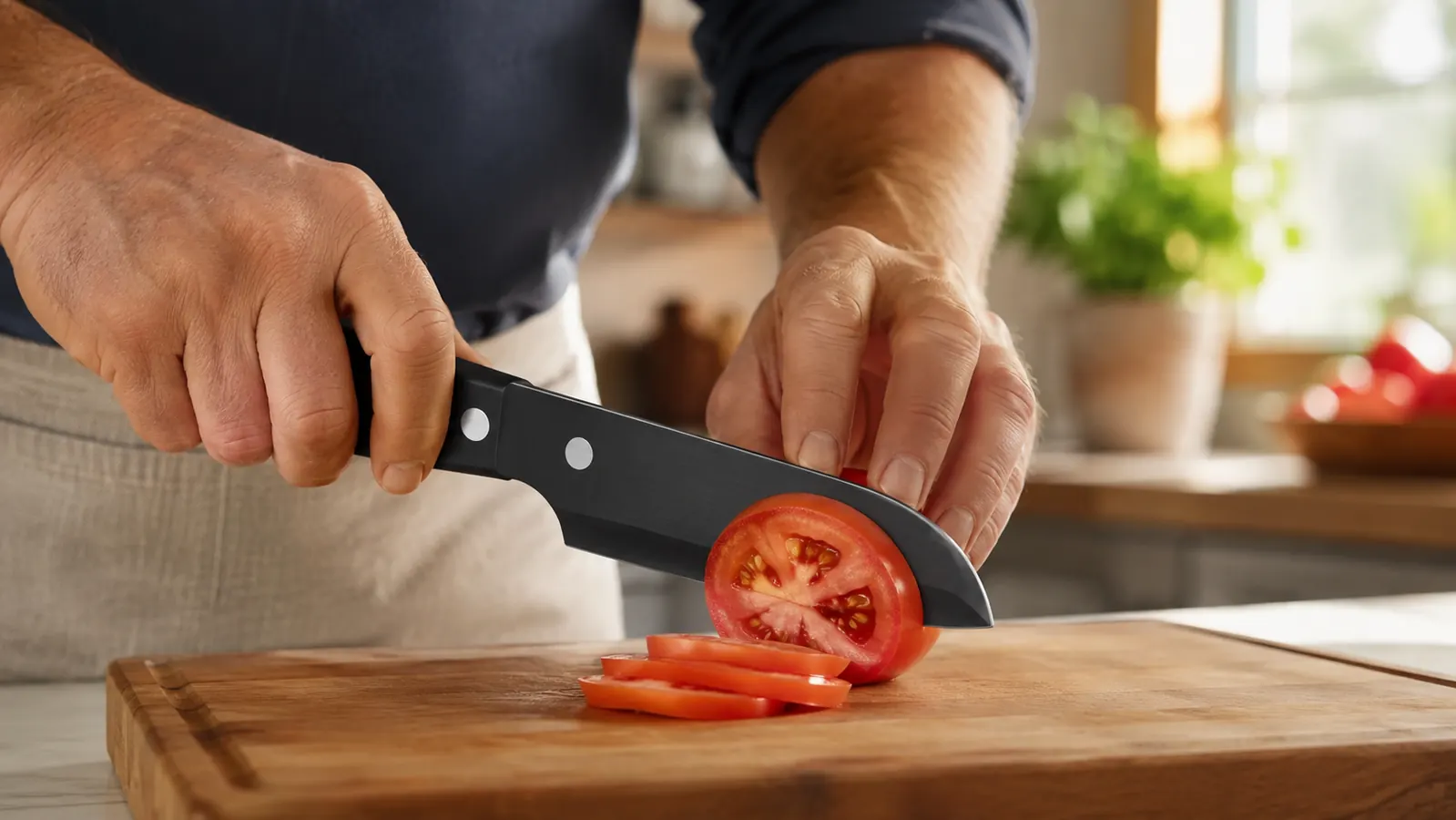
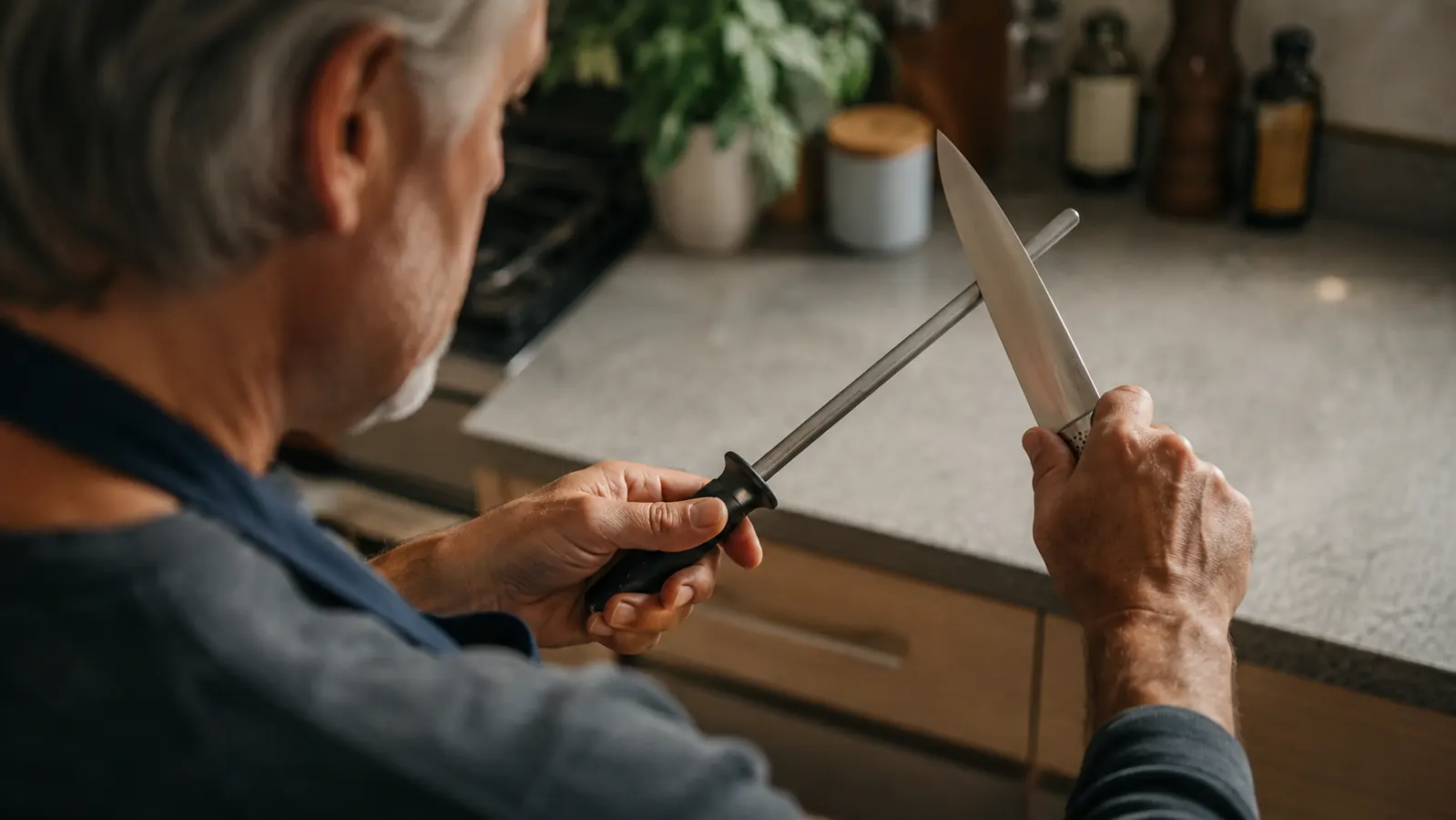
The honest headline for the Wüsthof is edge life and construction. It is forged from one bar of high-carbon German stainless, the X50CrMoV15 steel that Solingen forges are known for, heat treated to a harder Rockwell rating than the Victorinox. Translated to my kitchen counter, that means I run it over a honing steel about once a week and it keeps a working edge for months between sharpenings. The Victorinox takes the same weekly honing and starts drifting toward dull a couple of weeks sooner, reliably, every cycle.
The second argument is feel, and it is the one I cannot put on a spec sheet. The Wüsthof is one forged piece, bolster, tang and blade out of a single bar, eight and a half ounces. That weight is not dead weight, it is the knife doing the work. A butternut squash, a pork shoulder, a three-pound pile of onions, the momentum of the blade carries through the food instead of your wrist forcing it. The full tang runs the length of the handle, so balance sits forward in your grip the way a knife should. Pick one up, grab an onion, and you will feel it in the first thirty seconds.
Where the Victorinox Wins
Now the honest case for the Swiss knife, and it is a strong one. Price first: today's Victorinox Fibrox costs a fraction of today's Wüsthof Classic, and the cheaper knife will absolutely carry a week of home dinners. There is a reason you see these on every commercial kitchen rail, they are the standard rental-kitchen and prep-kitchen knife in America. If your budget already knows what a knife is worth to you, this stops being a close call. It is not a worse knife, it is a lighter spec at a lighter price, and for a lot of kitchens that is the correct spec.
Second is comfort and tolerance. The Fibrox handle is a textured nylon that grips better wet than anything I have used, and at about four ounces the whole knife disappears in your hand, which is a real thing on an older wrist during a long prep. It is also the closest thing to dishwasher safe you will get on a serious knife. I hand-wash mine anyway, but a house that runs dishes through the machine can get away with it. And when the edge finally does give out, the softer steel comes back on a whetstone in ten minutes, which is far friendlier to a beginner than the harder Wüsthof.
What You're Paying For: The Steel
Since the price difference is the whole argument of this article, let me put it in real terms. Forging means one bar of X50CrMoV15 steel gets heated, hammered, ground and tempered in Solingen, Germany, and heat treated to a harder reading than the stamped Victorinox. Harder steel holds a finer edge for longer, and it is also more brittle, so it wants a proper honing rod and a real wooden or plastic cutting board instead of a careless drawer and a glass board. The Victorinox is stamped from a sheet of the same steel family, a touch softer, which is exactly why it takes a razor edge in minutes and lets it go a little sooner.
Neither steel is better in a vacuum, and the internet will try to convince you otherwise. Harder steel is better at what the Wüsthof is for, holding an edge through serious repeated use. Softer steel is better at what the Victorinox is for, being cheap, forgiving and easy to bring back. Forging is not a quality score, it is a spec choice, and the right spec depends on the cook. For me the choice was obvious, because I use the same knife every single day and I am done buying knives.
Comfort When the Cutting Runs Long
Comfort is the thing the reviews gloss over, and it is the real reason I ended up with the Wüsthof. I cooked with a Victorinox for years and loved it. Then one Christmas I prepped a party's worth of food with a forged knife, and somewhere around hour three I noticed my hand was not doing the little cringe it always did with the lighter blade. The weight does it. Eight and a half ounces sounds heavy on paper, but in use the blade falls through food under its own gravity and your grip stays loose the whole session.
The catch, honestly, is wet hands. The Wüsthof's synthetic handle is smooth and polished, and it does not grip like the Victorinox's textured nylon. Set it down in a puddle of board juice, grab it with wet hands, and you will notice. My fix is a dry towel, which every cook already owns. But if a slippery handle has ever cost you a fingertip, you need to weigh the Victorinox's texture into your decision. That is a real tradeoff, and it is the fairest thing I can tell you about the Wüsthof.
The weight is not dead weight. It is the knife doing the work so your wrist does not have to.
The Year Behind This Comparison
To be fair to both companies, I should be specific about how this comparison was built. I bought my Victorinox Fibrox in 2016 and used it as my only chef's knife for three years, roughly six dinners a week, honing it on a steel and sharpening it on a 1000-grit stone three or four times a year. I bought the Wüsthof Classic in January of 2024 and have used it daily since, same hone routine, and I have touched it to the stone twice in that whole stretch. Those are the two data points, and they are the difference in a sentence.
The dirty secret of the whole debate is that both knives will do 95 percent of what the other does. I have never once failed to make dinner because my knife was the Victorinox instead of the Wüsthof, and I have never once regretted the Wüsthof when I was three hours into a prep. The difference shows up in the last ten percent: edge life, feel on long sessions, and the confidence that comes from a knife that is not going to flex or fail. You are paying for that last ten percent, and only you can say whether it is worth it.
Oh, and one thing nobody tells you: the Victorinox is so light that it can feel fragile the first time you handle it, and the Wüsthof is heavy enough that people used to stamped knives set it down with a clunk. Neither of those feelings means the knife is wrong. They are just the two spec choices showing up in your hand, which is exactly what this article is about.
One knife you will never have to re-buy.
I have laid the tradeoffs out straight, and weighed against a Victorinox the Wüsthof Classic wins on edge life and feel and loses on price and wet grip. If the edge life and feel are the parts that matter to you, check today's price before you buy, because it moves around.
Amazon Check Today's Price on Amazon →Who Should Buy Which
Buy the Wüsthof Classic if you cook nearly every day, if you are tired of knives that go dull mid-dinner, and if the phrase one good knife for the next twenty years sounds like a better deal than a new knife every few years. Buy it if you will hone it once a week and hand-wash it, because that is the one non-negotiable. This is the tool for a cook who treats the kitchen the way I treat the garage: buy the good tool once and it outlasts every excuse to replace it.
Buy the Victorinox if you cook a few nights a week, if this is your first serious knife, if you share knives with people who run them through the dishwasher, or if the difference simply does not show up in your hand. There is nothing wrong with any of that, and the Victorinox will still feel like a revelation next to whatever cheap knife you are replacing. The only genuinely wrong move in this entire article is spending Wüsthof money and then being scared to use it, which I have watched people do for years.
The Verdict in One Paragraph
If you put both in front of me and told me to keep one, I keep the Wüsthof Classic, and it has nothing to do with Germany or prestige or the price tag. It is simply the knife that has held an edge for two and a half years with two sharpenings, the knife that falls through a squash under its own weight, the knife I reach for without thinking. And if your hand or your budget tells you the Victorinox, you are not buying second best, you are buying the right tool. Both of these knives are honest. That is the rarest thing in kitchen gear, and you get it either way.
The bottom line: buy the knife you will actually reach for.
For me that is the Wüsthof Classic, used daily for two and a half years and counting. If that is the knife you want, the link below takes you to today's price. If the Victorinox is the right call for your hand and your budget, go get it, and do not let anyone talk you out of a good decision.
Amazon See Today's Price on Amazon →