

Read the reviews for the Wüsthof Classic chef's knife and you will meet the same phrases over and over: perfect, the last kitchen knife you will ever buy, wish I had done this twenty years ago. Nearly three thousand ratings and it sits at 4.8 stars. That is not a review section anymore, that is a consensus. And still I spent a week talking myself out of the purchase, because handing over that kind of money for a single blade is exactly the thing a sixty-something home cook thinks twice about. This is the review I was hunting for during that week. The one that tells you what the 4.8 stars do not, before you spend today's price.
Here is who is talking. I have cooked almost every night of my adult life since the late seventies, I keep my hands busy in the garage with the car and at the hangar with the airplane, and my knife drawer is a museum of forty years of bad decisions. Bent stamped blades, a knife whose handle came loose in month two, a ceramic blade that chipped on one sweet potato and never came back. I bought a set of steak knives from a discount store years ago, and the very first one dented on a frozen loaf. So I was never going to buy the popular expensive knife on faith alone. I bought the Wüsthof Classic anyway, and I have spent long enough with it now that the honeymoon is thoroughly over. What follows is the version I could not find anywhere else.
The Quick Verdict
It is not magic on day one. The magic is that it still cuts like day one at month six while everything cheaper in my drawer quietly quits. Buy it if one good knife is in your budget and you will look after it.
Amazon Check Today's Price →Still reading the same five-star verdict twice?
The honest version, before you hand over the money. If you cook most nights and you want one knife to end the dull-blade cycle, check today's price and decide with the whole picture.
Amazon Check Today's Price on Amazon →How I've Used It
The honest scope is that it is my only chef's knife and it has not been treated like a showpiece. On a normal week it does two or three prep sessions a night: onions, peppers, garlic, tomatoes for the salad, chicken breast, and a whole bird on Sundays when the grandkids come over. I have used it on wood boards, a bamboo board, and one polished stone countertop that I will never use again, because the sound it made told me everything I needed to know about boards and edges. It has broken down a turkey, sliced brisket after a long smoke, and diced more onions than I care to count.
I keep a honing steel beside the cutting board the way I keep a torque wrench by the workbench, and that is the whole maintenance story. The knife gets wiped and dried by hand, and it has been properly sharpened a handful of times since I bought it, always with the same result. It comes back to the same level it left with, and it sits there. That consistency is the part I did not believe until I saw it.
There is no ceremony around this knife, and that is exactly the point. It lives out on the counter beside the steel, not buried in a drawer, and I reach for it without thinking the way I reach for a breaker bar at the track. Prep used to be a chore I got through. Now it is twenty minutes of plain, comfortable work, and this knife is the reason I stopped dreading it.
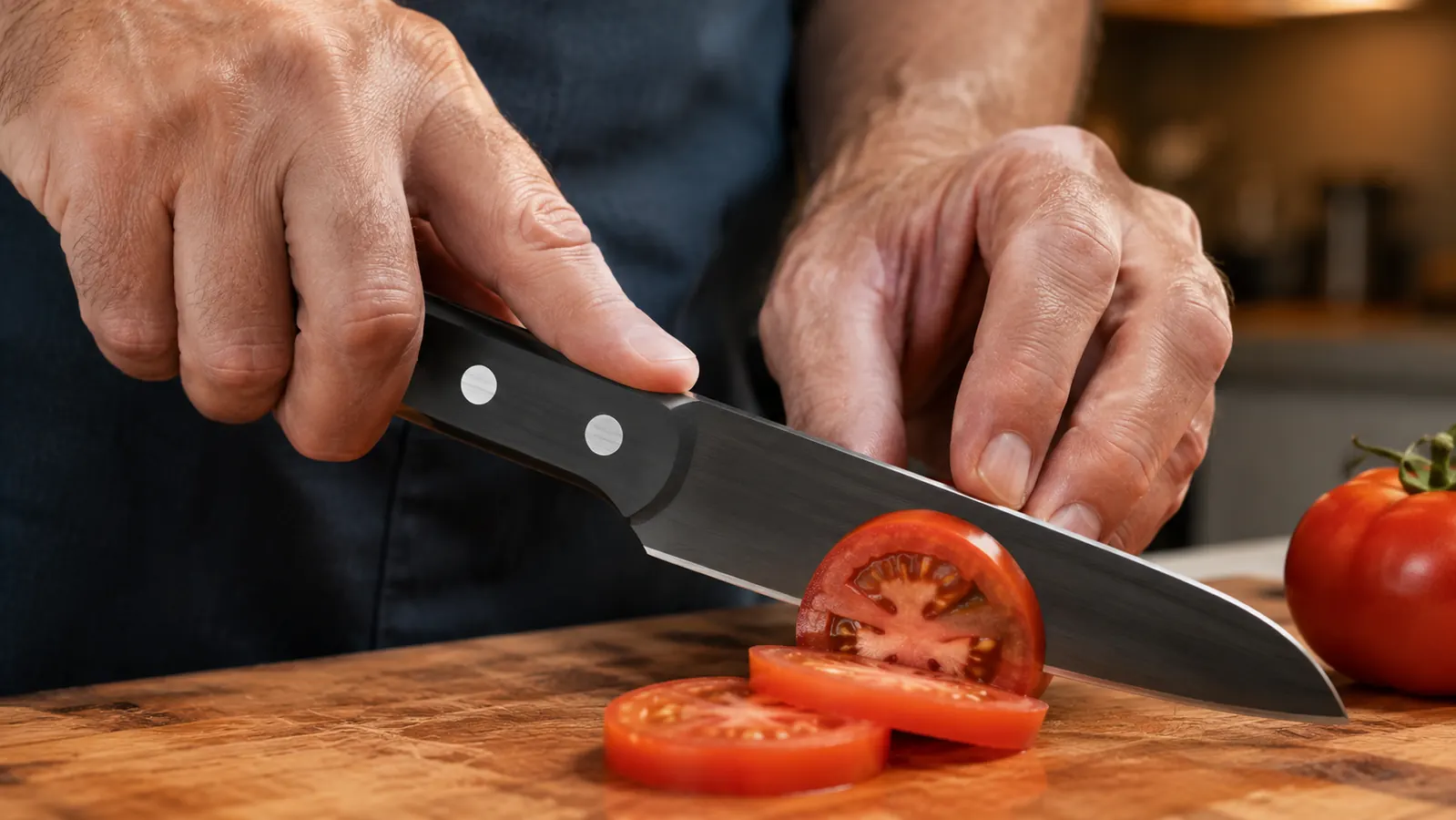
What the 4.8 Stars Actually Hide
Here is something nobody says about a 4.8 average with nearly three thousand ratings: it hides the split. Most of those buyers came up from a worse knife, often a badly beaten stamped blade, so of course this thing felt like a revelation to them. They are not comparing it to a laser-edged Japanese knife or to a lighter German alternative. They are comparing it to the dull serrated thing they finally threw out. The average is real, but it measures a jump in quality you may or may not be making from where you currently sit.
The stars also hide timing. The confused buyers write their review in week one, when the knife still feels heavy and unfamiliar and they cannot find the magic the teaser made them expect. The satisfied buyers write at month six, after the edge has outlasted several sharpenings of anything they owned before. So that big number is really the average of two different experiences, the first week and the first year. Which one you land on is mostly up to how you handle the first two weeks.
For the record, the written reviews are not wrong. The edge life claims, the balance comments, the longevity stories, I have hit the same notes myself. What they do is pick the most flattering framing of each truth. The knife holds an edge, yes, with weekly honing and a real cutting board. The balance is good, yes, once a heavier blade stops feeling alien to you. Every rave has a condition hidden in it. This review is those conditions, named out loud. Underline what comes next, because it is the difference between the kind of review that raves and the knife you actually own: this blade performs only as well as the habit you feed it. A wood board, a few passes on the steel, a hand wash. Feed it that, and the raves make sense. Starve it, and you will write the other kind of review, the one-star complaint about a premium knife that somehow came dull.
The First Two Weeks Are the Hardest Part
Nobody tells you the first two weeks are the worst of it, because nobody wants to admit buyer's remorse out loud. The knife arrives heavy, about eight and a half ounces with the full tang, and if you are coming from a light stamped blade it feels like holding a small pry bar. You will wobble it, cut one tomato, and wonder what exactly you paid for, because a fresh budget knife of any brand out of the box also cuts a tomato. I know this because I stood exactly there.
What stopped me from sending it back was a test I am glad I did. I pulled the old cheap knife out of the drawer and used it for one night, just to compare, and the difference I had stopped noticing came roaring back. The wobble on a hard onion. The way it skated across a pepper skin. The way I had to push, not glide, through a piece of pork. That is when it clicked that the Classic is not sold on day one. It is sold on day ninety, and you only get there by pushing through the first two weeks. I have watched two friends hit the same wall, one of whom returned it and one of whom did not. Guess which one still brings up the knife when we are cooking together.
The Handle Is the Part Nobody Reviews Honestly
The handle is the piece every perfect review glides past. It is smooth and polished, and that polish has a cost. With wet hands, or after handling a raw chicken, the grip gives you less to hang onto than a textured handle would, and I have had one moment early on where the knife shifted in my hand right after rinsing it under the tap. It never fell, and I have since learned to dry my hands before picking it up, but it is a real quibble and it is exactly the kind of thing the five-star crowd skips. These days I keep a dry kitchen towel draped over the edge of the counter, and I grab it before I pick the knife up after rinsing a bird. It sounds like fussing. It is two seconds of habit, and it is the whole difference between a knife that feels precarious and one I trust at full speed.
The bolster, the thick collar of steel where the handle meets the blade, is the other thing nobody warns about. It keeps your fingers off the edge, which is genuinely good. It also makes the rearmost inch of the blade, the section closest to the guard, a genuine pain to reach with a whetstone, because the bolster blocks the stone from lying flat. Most owners never notice because most cooks rarely use that last inch anyway. I am one of them. Small, honest dings, and again, the kind of detail the reviews leave out.
Then there is the care requirement, which nobody treats as a requirement. Hand wash, dry it, never the dishwasher, never a glass board. The dishwasher is the one that gets people. The heat cycles attack the handle, and the detergent dulls the edge faster than any amount of cutting. I learned the hard way with a previous knife, so this one is home free. None of this is hard. It is just a condition you accept before buying, not after.
The 4.8 stars are the average of two very different people: the confused buyer on day three and the satisfied owner on day ninety. You get to choose which one you become.

It Is Not a Magic Knife, and That Is the Point
Sell yourself the truth first. This knife will not make you a better cook, and it will not cut faster than a brand-new budget knife in week one, because sharp is sharp and a new budget blade is sharp. What it does is stay sharp. The cheap blade keeps paying for its price tag quietly, going dull by the middle of the month, taking abuse from a pull-through sharpener, losing its edge without sending you a memo. The Wüsthof Classic fades in a slow, readable arc, so you feel it soften a week before it becomes a problem, not on the night you are wrist-deep in onions.
That slow, readable decline is the entire argument for the money. A knife is not a one-time purchase, it is an ongoing relationship between steel, board, and sharpening. Buy the tool that makes that relationship pleasant instead of a monthly fight, and the price becomes arithmetic. I have stopped counting how many cheap knives I would have burned through by now. It is more than one, and that is the honest bottom line.
A word on boards while I am here, because boards and steel have an argument that never ends. This knife wants a wood or a good synthetic board. Glass, stone, and ceramic board surfaces roll the edge over frighteningly fast, and no amount of knife quality fixes that, because the board is the thing doing the damage. I have one glass board in the house left over from a wedding gift and it lives in the back of a cabinet, for display only. Consider that part of the real cost of a knife this good.
Is It Worth Today's Price, Answered Honestly
Is it worth today's price? For me, yes, and the reasoning is plain. I use this knife more than any other tool I own because I cook most nights. Spread the cost over the years a full-tang forged blade lasts, and the daily cost is pocket change, especially next to the alternative I lived with for decades: buying a cheap knife every year or two, living with a dull edge in between, and paying all over again. Do that math enough times and the expensive knife becomes the cheap one.
The counterargument is fair and I will state it plainly. If you cook twice a month, or you already have a knife you genuinely like and are only here because the numbers are big, this is not for you. A forged German blade is a commitment to something heavy, hand-washed, and honed. It rewards the person who cooks often and pays attention. That is the honest line, and I will hold to it through the whole review.
One more honest note about the money. I see people call this a splurge, and it is. But I also see people spend the same money on a set of four knives they use one of, or on a knife block that holds eight blades they rotate through like moods. If you are that person, the single good knife is not the more expensive choice, it is the cheaper one wearing a different label. That framing helped me, so I am passing it along.
What I Liked
- Still cuts like a new knife at month six, with a weekly hone
- Full-tang forged build that will outlive a drawer of cheap blades
- Heavy blade does the work for you on hard vegetables
- Slow, visible decline instead of a sudden dull drop-off
- One knife handles ninety percent of what a home kitchen throws at it
Where It Falls Short
- The polished handle is slick with wet or greasy hands
- The bolster makes the heel of the blade awkward to sharpen
- Heavy and unfamiliar for the first two weeks, which is exactly when you doubt it
- Real money for a single knife, and no way around that
- Demands hand washing, a real cutting board, and a weekly hone
Who This Is For
This is for the cook who wants one knife and wants it to be the last one. The person who already owns the cheap version of everything and is tired of replacing them. If you cook most nights, you will actually use the edge this thing holds, and the weekly hone will feel like a habit rather than a chore. If you like tools that reward attention, the way a well-set timing chain does or an airplane that is rigged properly, you will get along with this knife. If you have reached the age where you would rather own one good tool than six mediocre ones, this is the kitchen version of that decision. Buy it for exactly that person, because that person is you or it is nobody.
Who Should Skip It
Skip it if money is genuinely tight, because the honest cheap answer cuts food fine and the price of this knife is a luxury you can defer. Skip it if you want a light knife, because the weight will always feel like a pry bar to you, and no amount of breaking in changes that. Skip it if everything in your house goes in the dishwasher, because this knife will punish you for it. And skip it if you already have a knife you love, because the only honest reason to buy this one is that you are currently cooking with something you do not love.
Ready to find out what the 4.8 stars are hiding?
I kept my Wüsthof through the doubt and it became the last chef's knife I will buy. If you cook most nights and want the whole honest picture before you commit, check today's price.
Amazon Check Today's Price on Amazon →