

Last January I finally did what I'd been putting off for years. I bagged up every orphaned container in my kitchen, maybe forty mismatched pieces, and ordered the Rubbermaid Brilliance set to replace them all. Twelve months later, with this set in and out of the dishwasher nearly every night and into the microwave most weekdays, here is the honest long haul. Ten pieces sounds small next to the drawer it replaced, until you realize most of that drawer was homeless lids. Of the forty pieces I tossed, thirty one had a usable base with no matching lid, or a lid that had lost its snap and belonged to nobody. That is twenty years of cheap storage in one tally.
I know the cycle you're in if you're reading this. The cheap tubs that stain the first time they meet spaghetti sauce. The lids that stop sealing after a month and then disappear. The freezer burn on food you know you sealed. I wrote this so you can skip the next rotation and buy once, the way I finally did. If you read nothing else, read the lid section, because the lid is where almost every cheap set dies.
The Quick Verdict
After a year of daily leftovers, packed lunches and a dishwasher that runs every night, the Rubbermaid Brilliance set is the first food storage I've owned that still looks new. The four-latch seals hold, the plastic stays clear, and I haven't thrown out a single piece.
Amazon Check Today's Price →The Last Storage Set You'll Need to Buy
Four-corner latch lids that seal airtight, clear plastic that won't stain, and a year of proof from a busy kitchen. If your drawer is half lids and no bases, this is the fix.
Amazon Check Today's Price on Amazon →How I've Used It
I run a normal busy kitchen, not a test bench. The set splits duties every week: the largest pieces hold a full pot roast or stew's worth of leftovers, the middle ones carry my lunches, and the smallest one rides in a cooler on trips to the airfield, holding a day's sandwiches and a bottle of water frozen to keep them cold.
I haven't coddled these containers. They've been microwaved, frozen, dropped once on a tile floor, and run through the dishwasher on the top rack hundreds of times. The microwave is the real test, because cheap polypropylene warps and flexes when it gets hot. None of these have, not once in a year.
The specific that convinced me: the smallest piece has traveled in my lunch bag twice a week since March, riding on its side with salad dressing inside. It has not leaked, not a drop. I cannot say that about a single container I owned before this set.
The freezer test gets less press than the microwave but matters just as much. I portion bulk-cooked beans and chili into the medium pieces and freeze them flat, so they thaw in a pan in about twenty minutes. They come out of the freezer without cracked corners and without ice crystals clinging to the walls, which tells me the seal held through the whole temperature swing. I also have a brick of lentil soup that has sat in the freezer since March, thawed under warm running water, and the seal line peeled clean with no prying and no flex crack. The freezer is where cheap plastic does its dirtiest work. Every brick has held.
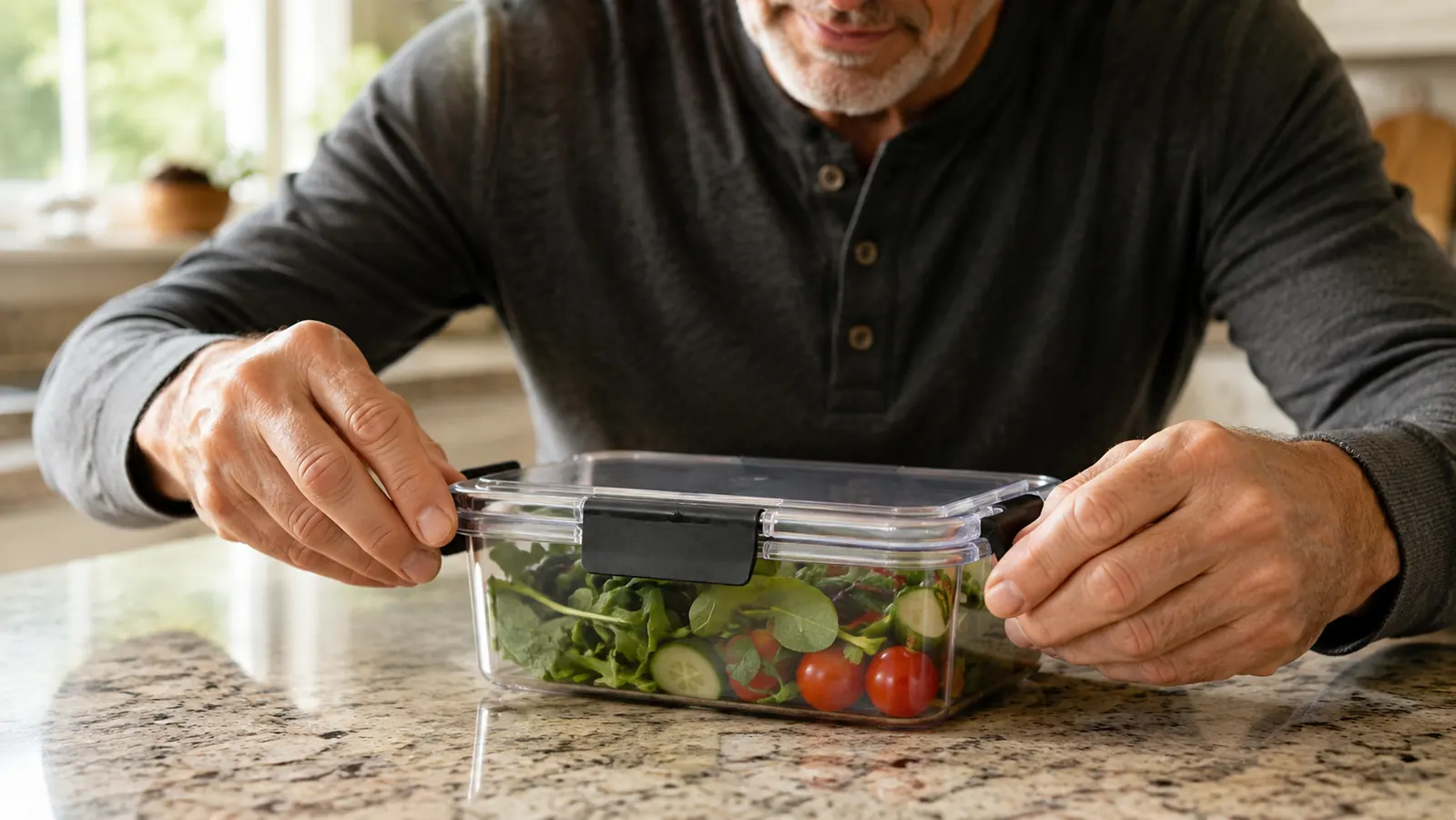
The Four Latch Lids Are the Whole Story
What sets these apart is the lid design. Instead of one weak snap in the middle, each of the four sides locks down against a silicone gasket that runs the whole rim. When all four click shut, the seal pulls the air out of the container, and you can see the lid sit slightly concave. That concave look is the seal doing its job, not a defect.
An airtight lid is what keeps cut fruit from drying out, keeps soup from sloshing across a shelf, and keeps a half onion from perfuming the whole refrigerator. Because the seal lives in the gasket rather than in a flimsy hinge, it holds up to months of opening and closing instead of dying in the first month like every snap lid I've owned.
The tradeoff is real and I won't dress it up: four latches take two hands and a bit of fuss. This is not a one-thumb snap lid. When my hands are greasy from handling meat I have to wipe a thumb before the last latch will close. That's the price of the seal, and after a year of carrying dressings sideways in a lunch bag, I'll pay it every time.
I also tested the leak-proof claim the way you actually use it. I filled the largest piece to the rim with leftover stew, snapped all four latches, and tipped it upside down over the sink. Not a drop. Then I tried the harder job, a half-empty container with a pocket of air in it, and it still held. That's the claim that actually checks out. And a year in, all twenty latches across the set still click with the same snap they had in January. I braced for the rear tab to soften where my thumb lands every day, because that is where every cheap hinge I have owned gave up first. None of them have loosened, and the gaskets have never needed reseating.
Clear Plastic That Actually Stays Clear
The containers are made from BPA-free clear plastic that is thick enough to feel substantial, and the feature most people ask about first is the one that holds up: the plastic doesn't stain. I have stored chili, marinara, turmeric-heavy curry and beet salad in these. Every single one washed back to crystal with plain dish soap and the bottle brush. I picked those four on purpose because they are the foods that murder cheap tubs: marinara is the usual killer, but turmeric leaves a yellow ghost and beets leave a pink one that no scrubbing ever lifts from flimsy plastic. Here I can look straight through the wall after one hot wash, and a year in, nothing has even tinted a seam.
The other silent killer of plastic storage is odor. Onion and garlic odor seeps into weak plastic and stays forever, so your next sweet thing tastes faintly of last week's curry. These don't hold smells. After a wash I can't tell what was inside, which sounds small until you've opened a forgotten container six months later and not recoiled.
One honest caveat on care. The containers handle the dishwasher fine, and the manufacturer asks you to keep the lids and gaskets to the top rack, which I do. Bottom-rack heat next to the element is where cheap lids warp, so I don't risk mine down there. Two hundred top-rack cycles in, nothing has warped and nothing has yellowed. Dishwasher question, answered directly since everyone asks it: yes, the whole set survives a normal hot cycle, and I only keep the lids up top because the silicone gaskets like it better there. If your machine has a heated dry cycle, run it on low or prop the door when it finishes, because extreme heat is the one thing that ages food plastic faster than use. And when sauce does splatter on the outside, a quick rinse with the dish brush clears it before it dries into a haze, which is the other way cheap plastic goes gray over a year.
The Long Haul: What a Year Actually Did
After roughly two hundred dishwasher cycles and three hundred microwave trips, here is the damage report. The bodies are immaculate. No warping, no cracking, no yellowing. All twenty corner latches across the set still engage with the same click they had in January, and the silicone gaskets have never needed to be reseated. The only cosmetic sign of age is a slight surface haze on the outside of the largest base from years of sitting on the dishwasher rack, and it polishes right off with a scrub brush.
I meal prep on Sundays, which is the hardest job a storage container can do. Six filled pieces go into the fridge together, get scattered across the week, and come back to the wash pile with the rest. The lids stay matched to their bases because the design keeps them together, and after a year of Sunday cycles, not one lid has wandered off to a base it doesn't fit.
The only thing I watch is the latch tabs. They're the one piece of this design that can fail, and they fail from rough handling: twisting a stuck lid, or slamming a full container down on a counter hard enough to pop the corners. Treat them with basic respect and they'll outlast the decade. This is the first plastic set I've owned where the lids aren't the first thing to break.
Stacking is the sleeper feature. The pieces nest, and each lid snaps onto the base of the container below it, so the whole set occupies one fridge shelf in a footprint about the size of a cereal box. My refrigerator went from three shelves of anonymous plastic to one shelf of containers I can actually see into and identify without opening anything. And because the stack is clear plastic rather than opaque, I can see exactly how many servings of yesterday's stew are left by looking at one shelf, no opening required. Pulling one piece out of the middle of the stack is no wrestling match, which is why I have abandoned every other stacking system I tried. The container below holds steady because its lid is snapped to the base above it, so you lift one and the column stays put. On shelves too short for my tallest pieces, that column is the difference between one shelf and three.
And what did the year do to my confidence in the purchase itself? Every base still slides, every lid still clicks, and the set still reads as a matched set. That's the quiet thing that sells me on Rubbermaid Brilliance for the long term: there is no nearly-broken piece in my drawer waiting to fail.

When You Could Skip These (and the Honest Alternative)
Glass is the obvious alternative, and it's a good one for the right kitchen. Tempered glass gives you the same see-through convenience, zero risk of ever staining, and the one thing plastic can never offer: moving straight from the freezer into a conventional oven. If your routine is built around casseroles that go from freezer to oven in one step, glass should be your set.
For daily leftovers I reach for plastic every time, and the reason is a weight game, not a durability one. These pieces are light enough to grab, inspect and put back with one hand, and they don't threaten your toes when you juggle a stack down from a high cabinet. There's also no glass-on-glass screech when you pull one out of a crowded drawer.
If you're genuinely deciding between this set and a tempered glass brand like Glasslock, the full comparison lays the lid systems and the weight tradeoffs out side by side. Read both before you pick, because both are genuinely good and the right answer depends on how you reheat. One more honest note: replacement lids are sold separately if you do break one, which removes my biggest fear about a matched set. A single broken lid does not sentence its base to the back of the drawer.
What I Liked
- Four-latch lids seal airtight; nothing has leaked in a year of sideways lunches
- BPA-free clear plastic resists tomato, turmeric and beet stains completely
- Two hundred dishwasher cycles with no warping, cracking or yellowing
- Lids snap onto the base for stacking, so lids stay with their containers
- Safe for microwave, freezer and dishwasher, with lids on the top rack
Where It Falls Short
- Four-corner latches need two hands and a moment of fuss, not a one-thumb snap
- Latch tabs are the weak point and can break under rough twisting or hard drops
- Glass is still the better call if you reheat in a conventional oven
Twelve months in, the surprise isn't that the seals hold. It's that every piece still looks like the day I unpacked it.
Who This Is For
Buy the Rubbermaid Brilliance set if you actually store leftovers, if you pack lunches, if you want to see the chili before you commit to opening it, and if you're tired of replacing cracked, stained plastic every six months. It's for the cook who wants to be told what to buy once and then not think about it again. It's the set I'd buy again tomorrow without reading another option, and I haven't been able to say that about kitchen plastic in thirty years.
Who Should Skip It
Skip it if you're a committed glass owner, if you routinely reheat in a conventional oven, or if you need a lid you can close with one thumb while holding something else. And if this is your first storage upgrade, spend on the biggest set that fits your fridge rather than the smallest one. Future you, standing at the fridge with a full pot of stew, will be glad you did. And if you only store dry goods, flour, rice and pasta, plain canisters do that job just fine. The Brilliance set earns its keep on wet food, and that's exactly where the seal pays for itself.
Replace Your Loose-Lid Drawer Once, for Good
A year of daily use says these are the last containers you'll need to buy. Seal them, stack them, microwave them, and forget about them.
Amazon Check Today's Price on Amazon →