

I have a confession that would irritate my mother. For thirty years I cooked dried beans the way she did, soaked overnight and simmered for the better part of an afternoon. Then in August of 2025 I set the Instant Pot Duo on the counter, sealed the lid, and let a sixteen-ounce bag of pinto beans come out creamy from dry in about fifty minutes. I called her to brag. She told me to watch the valve. The valve has been fine for a year. Mom still does not own one. I have run this machine nearly every day since, and this is the honest long-term report.
I suspect you are weighing the same three options I weighed. The slow cooker gets you a good pot roast but it asks you to think about dinner at nine in the morning. The stovetop pressure cooker in someone's cabinet has scared people for generations, honestly, with the hissing valve and the dial, and mine sat unused for the same reason. Ordering out twice a week costs more than any appliance ever will. The Instant Pot Duo is the fourth answer, the one that does the pressure cooking, the slow cooking, the rice, the steaming, the sauteing and even the yogurt with a single lid and a single stainless liner. Twelve months later it is still on my counter.
The Quick Verdict
After a year and roughly four hundred sealed lids, the Instant Pot Duo is the most used appliance in my kitchen and the one I would replace the day it dies. If beans, rice or tough cuts are part of your cooking, buy once and be done.
Amazon Check Today's Price →The 6-Quart Duo I Have Run Every Day for a Year
It seals fast, vents when you tell it to, and the stainless liner sits in the dishwasher five nights a week. If this matches how you cook, today's price is the number to check.
Amazon Check Today's Price on Amazon →How I've Used It
For context on the word long-term: I am 59, I cook the weeknight meals for my wife and myself, and I bought the 6-quart Duo on August 12, 2025 because a ham that needed hours in a slow cooker was going to push dinner well past my patience. I sized it for two people with leftover lunches, and for the occasional whole chicken that does not crowd the entire counter. The six-quart has been the right size every single time.
Here is what it actually does, week in and week out. Dried beans once a week, pintos, black beans, chickpeas. Basmati rice twice a week, two cups and twelve minutes with a natural release, better texture than my old rice cooker ever delivered. A chuck roast or pork shoulder every couple of weeks. Eggs when I am being lazy. Yogurt on a Saturday when I remember to start it before bed. That is four or five uses a week for fifty-two weeks, and it has not skipped a beat.
The first week I handled it like a man who just bought something nice and was afraid to scratch it. By the third month I was scraping it with the flat side of a wooden spoon and not worrying. It has a scratch here and there now, the honest finish of a year of use, and none of those marks matter.
What the 7-in-1 Actually Buys You
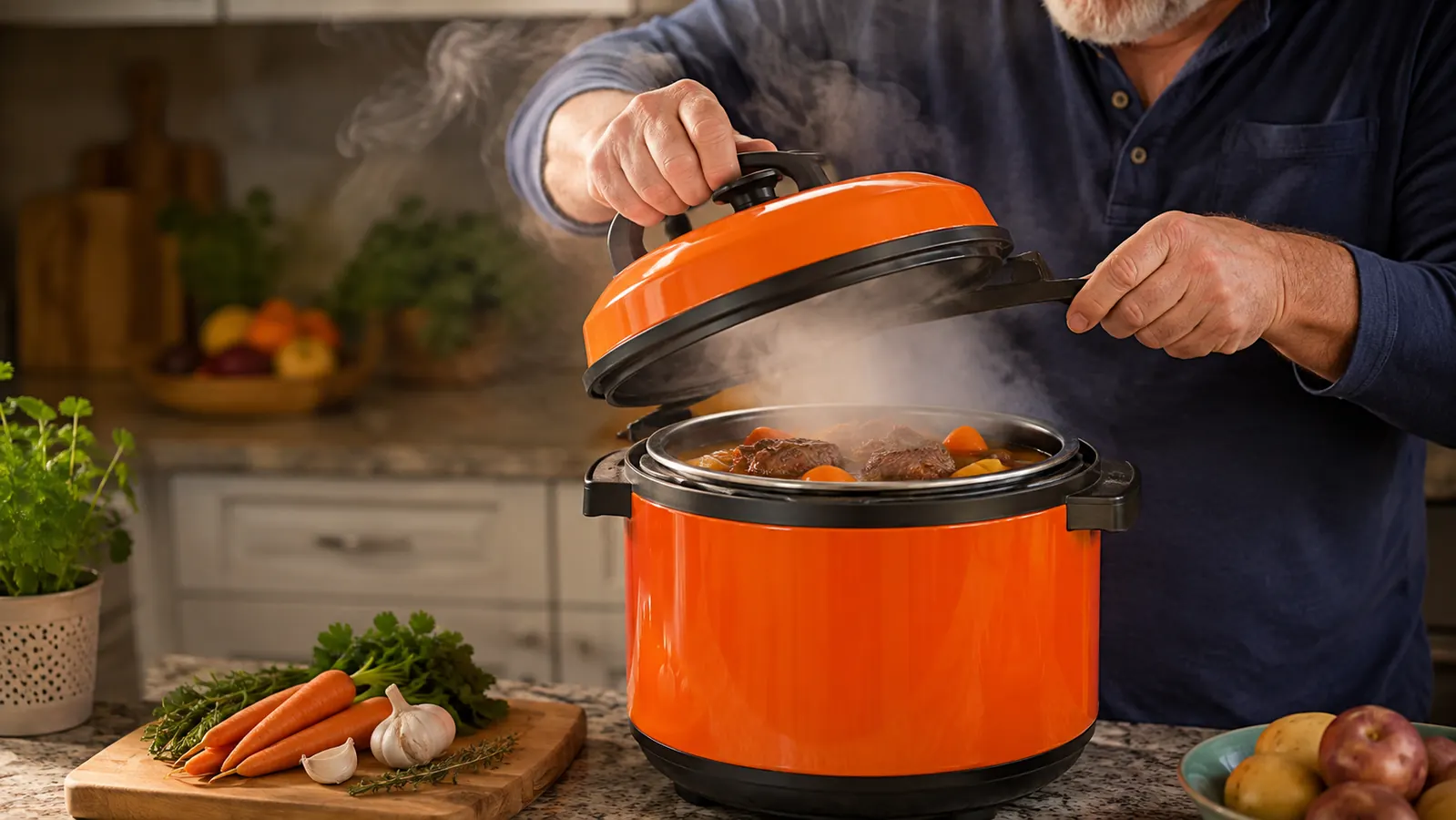
Start with the pressure cooking, because that is the muscle. The 6-quart draws 1000 watts and holds roughly 11 psi at high pressure, which raises the boiling point of water well past 212 degrees and breaks down connective tissue in a chuck roast in about 45 minutes instead of three hours. It has manual high and low pressure settings and a timer you set with the dial, no phone required. The keep warm mode holds food above serving temperature without cooking it further, and that has saved more than one late night for me. The single most useful habit for a beginner is the natural release: let the pressure drop on its own for ten minutes before you touch the valve, and big braises come out juicier and the counter stays dry. Quick release is for vegetables and eggs, not for a chuck roast.
Then the machines it retires. The rice setting cooks two cups of basmati in twelve minutes with the same steel liner every time, no scorching, because that liner is stainless steel, not a coated pan. The steam basket does broccoli and potatoes without dumping flavor down the drain. The slow cook setting exists for the people who want a seven hour pot roast, and the yogurt setting holds a steady temperature overnight so you wake up to breakfast yogurt instead of another gadget. One pot, one lid, and the whole stack fits in the space a rice cooker used to occupy. The Duo also keeps its moisture under a sealed lid when you leave it alone, which is half the reason the pot roasts come out of it moist instead of stringy.
The saute function is the one I would defend to a skeptic, because it is what separates pressure-cooked meat from pressure-cooked sludge. You brown the chuck roast in the same pot before you seal it, scrape the good browned bits into the liquid with the spoon when you release the lid, then lock everything down. That single step is why a 45 minute pressure cook tastes like it braised all afternoon. Skip it and the meat is still tender, just pale and less interesting.
The App Was the Surprise
I expected the companion app to be pure marketing, the kind of thing you pair once and forget. It is better than that. It carries more than 800 recipes and answers the real beginner question, which is not how to cook but for how long. A lamb shank at high pressure takes sixty minutes and a natural release. The app tells you, and in my first month it was right every time I followed it.
My honest long-term take: I leaned on it hard for the first month, bookmarked maybe a dozen recipes, and now I cook from the dial because I have memorized my usual times. If you have never pressure cooked, the app is a genuine safety net for your first ten cooks. After that it earns its place as a recipe drawer you open when you want to try something new. That is all I ask of a companion app.
How It's Held Up Over a Year
Mechanical stuff first, because that is what a man who wants equipment to last actually cares about. The lid locks and seals today exactly as it did in week one. The buttons have taken a year of daily taps without a dead pad. The quick release valve still vents with the same force it had out of the box, and the display is still legible under the range hood light. Not one part has needed replacing, and I have not been gentle.
Two things I learned along the way. The silicone sealing ring absorbs the smell of whatever you cooked last, tomato and garlic especially, which is the honest quirk of every pressure cooker on the market; rings are cheap and easy to swap, and I keep a second one for anything sweet. And the little condensation cup under the lid collects the drips and snaps out for the dishwasher. Small things, but they mean the whole machine goes through a sink cycle in two minutes.
The one ergonomic truth nobody puts in the listing: the pot is heavy when it is full of stock. I have the grip for it, but my wife pours one-handed and sloshes the counter. The fix is to ladle instead of pour, and then it is a non-issue. That is a real fact of every electric pressure cooker, not a defect of this one.
A dry bag of pintos takes my whole afternoon on the stovetop. In the Instant Pot Duo it is fifty minutes, and dinner is on the table by six. That one difference changed what I cook on a Tuesday.

Where It Falls Short
No honest review gets to skip the complaints, so here are mine in the order they have annoyed me. The slow cook setting runs hotter than a dedicated slow cooker, so a recipe written for seven or eight hours comes out done in closer to five or six. I learned to shorten the time and moved on, but it is a genuine difference and you should know it before you retire your old slow cooker.
Second, the liner is stainless steel, which means no nonstick shortcut. Sticky rice and cheese sauce need a soak, ten minutes in warm soapy water, then one scrub and it is clean. Third, the saute setting runs hotter than the dial suggests and oil will smoke if you walk away; you brown, add liquid, and move on, you do not preheat it and leave it. And nothing that comes out of a pressure cooker will ever have a crust. This machine braises. It does not sear a finish onto anything.
And the value math, since the Amazon page will not say it plainly. If beans, rice and braising cuts are regulars at your house, the 6-quart pays for itself inside a year at today's price against takeout and canned goods. If you mostly heat things up and never cook a tough cut, it becomes an expensive lid holder that gets moved off the counter by March. Know which house you live in before you buy.
What I Almost Bought Instead
I looked hard at three alternatives before I committed. The combo machines that bolt an air fryer lid onto a pressure cooker are genuinely tempting, but they cost more, and I already own a countertop air fryer that does that one job better. A stovetop pressure cooker is faster and more thrilling to run, but the one I once owned lived in the cabinet because I did not trust the gauge, and an appliance in the cabinet earns zero dinners.
The third alternative was doing nothing, keeping the slow cooker and the rice cooker and the Wednesday takeout habit. The math that settled it: one walk to the Chinese place a week, plus slow cooker prep at nine in the morning, cost more of my week than the Duo cost in a month. When one pot retired three appliances and one weekly takeout run, the question about counter space answered itself. I still keep the cardboard box in the garage, not because I expect to need a return, but because a year of use has not given me a reason to throw it away.
What I Liked
- Dried beans from dry in about 50 minutes, no overnight soak, creamier than my slow cooker ever produced
- Seven functions share one lid and one stainless liner, so the whole machine replaces three appliances
- Saute then pressure means one dirty pot for a pot roast that tastes slow-cooked
- More than 170,000 ratings averaging 4.7 stars, and cheap spare parts everywhere
Where It Falls Short
- The slow cook setting runs hotter than a dedicated slow cooker; plan for shorter cook times
- Stainless liner needs a soak for sticky rice and cheese sauce, no nonstick shortcut
- The pot is heavy when full, and the quick release is loud enough to startle the dog
- The app is a real help for your first ten cooks, then it fades out of the routine
Who This Is For
Buy the Instant Pot Duo if beans, rice and braising cuts are regulars in your rotation, if you are tired of deciding dinner at nine in the morning for the slow cooker, or if a stovetop pressure unit always looked like too much machinery with too many dials. It is the right first pressure cooker and a perfectly good fiftieth. If you are feeding a young family rather than two, the 6-quart is the size that fills the table without ruling the whole counter, and the steel body shrugs off the dings a cheap plastic unit would show. If you are still deciding between electric and stovetop, our full Instant Pot vs stovetop comparison lays out which one fits a practical kitchen, and the ten reasons a multicooker earns its counter space make the case for this format.
Who Should Skip It
Skip it if you mostly cook for one and only heat things up, because from January to March it will sit there. Skip it if the slow cooker is your only slow cooking need and you already love yours, since a dedicated slow cooker does that one job better than the Duo's hotter setting. Skip it if crisp skin and a seared crust are what you cook for, this is braising equipment and it is honest about that. And if beans, rice and tough cuts show up on your menu less than a few times a month, save the counter space. This is not the tool for you.
Buy the One That Lasted a Year and Get Your Evenings Back
After about four hundred sealed lids, not one part of my Duo has failed. If beans, rice and pot roast are on your menu, check today's price and tell me next year it paid for itself.
Amazon Check Today's Price on Amazon →