
I have been replacing nonstick pans every two years or so since I moved out on my own. Watch the coating start to flake, coddle it for six more months, toss it, buy the next one. It is a subscription with a hardware store. Then my father in law handed me his mother's skillet, and I finally got the math. It is a 12-inch Lodge cast iron skillet, and it is the last frying pan I ever expect to buy.
Why does a pan outlast a kitchen? Same reason a big block V8 outlasts three econoboxes, less to go wrong. No coating layer to wear out, no riveted handle to shear off, no sensors, no nonstick surface waiting to give up. Just one solid casting of iron and a layer of cooked-on oil that rebuilds itself every time you use it. That is not marketing. It is material science you can hold in one hand, all five and a half pounds of it.
The Pan You Buy Once and Hand Down
This is the 12-inch Lodge I am talking about. At today's price it costs about the same as a decent large nonstick pan, and it will outlive three of them. Worth a look before you buy another coated pan.
Amazon Check Today's Price on Amazon →Before we dig in, one thing up front. I am not telling you cast iron is the best pan for everything, because it is not. It is heavy, it wants a minute more of forethought on heat, and it has a care routine your dishwasher will mock. What I am telling you is that if your goal is buying one frying pan that survives you, this is how that works. Ten reasons, and every one of them is something I have had to learn the slow way.
One Solid Piece of Iron, So Nothing Can Flake Off
A coating pan dies from the inside out. The nonstick layer flakes, scratches, then comes off in your eggs and you are done. The Lodge is cast in one piece, top to bottom. There is no coating layer at all. What protects the iron is seasoning, which is just oil cooked into a hard, slick surface. When the seasoning wears thin, the fix is not a new pan. It is cooking in it.
Seasoning Gets Better With Use, Not Worse
Every other pan you own peaks on day one. This one peaks about never. Each time you cook, a microscopic film of oil polymerizes onto the iron and the surface gets a little slicker. Think engine break-in. A skillet that has been cooked in for twenty years is noticeably better than the same skillet out of the box. My father in law's pan had decades on it, and eggs slid off it like a fresh nonstick.
Scratches Are Cosmetic, Not Fatal
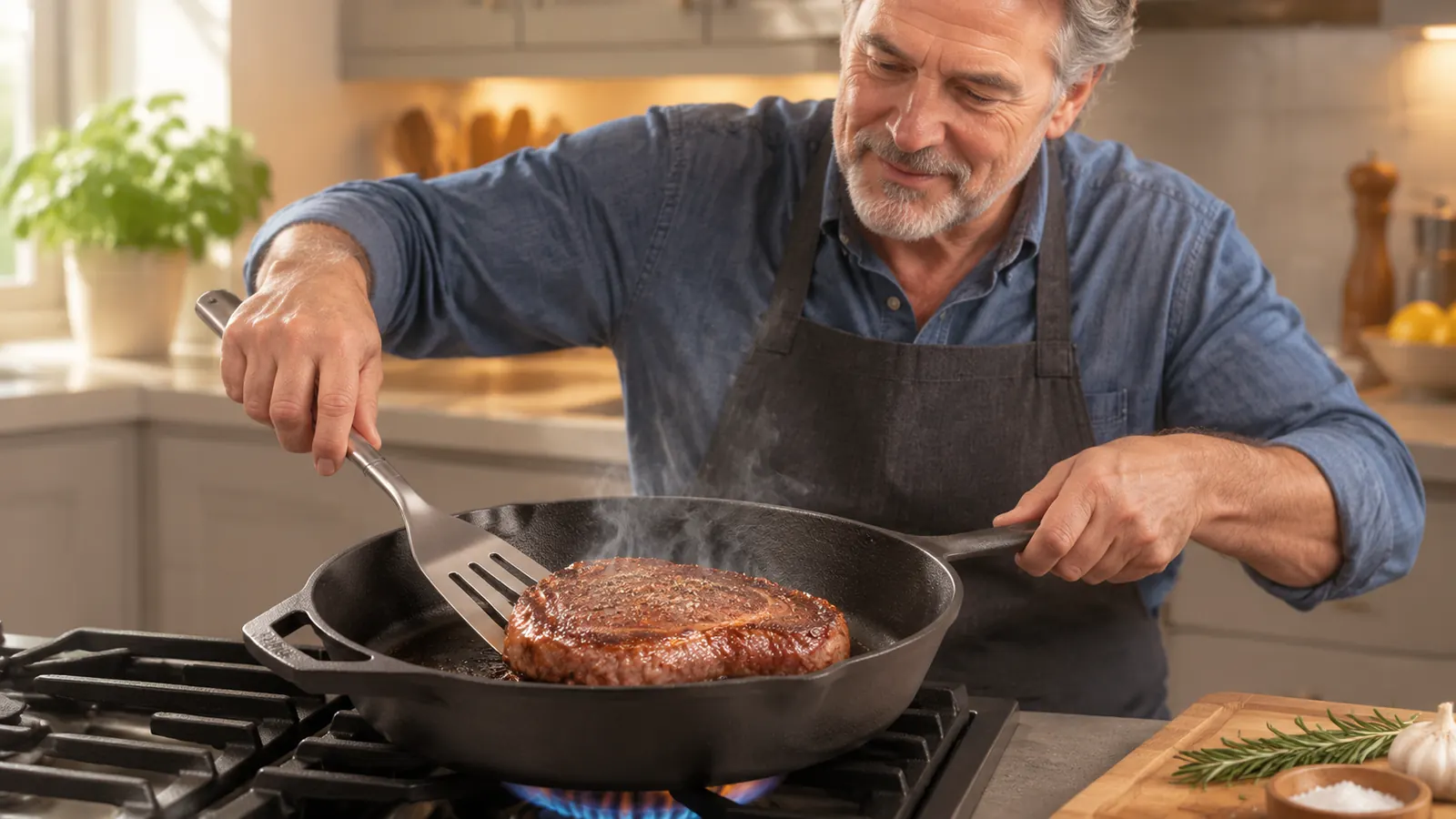
I use a metal spatula in mine. I scrape, flip, and occasionally gouge the surface, and nothing happens. On a coated pan, one good metal scratch is the beginning of the end. On cast iron, a scratch is a mark in the seasoning, and the next cook with a little oil fills it right back in. That tolerance for rough use is something no other pan I own has.
It Holds Heat Like a Flywheel
Thin pans shed heat the instant you add cold food, which is why cheap pans sear pale. The 12-inch Lodge weighs about five and a half pounds, and most of that is thermal mass. Drop a cold steak in and the pan barely flinches. You get a real crust instead of a gray steamed stripe. For a guy who cooks a ribeye after working under the car all day, that is the whole point.
Oven to Broiler to Campfire, No Temperature Ceiling
There is no plastic handle to melt and no coating rated to 500 degrees and done. Even the silicone handle grip comes off. The Lodge goes straight from a stovetop sear into a 450 degree oven, or under the broiler, or onto an open campfire for that matter. Very few pans in your kitchen can follow the heat that far, and that range is exactly why cornbread and frittatas come out right in it.
Rust Is Fixable, and So Is a Lost Seasoning
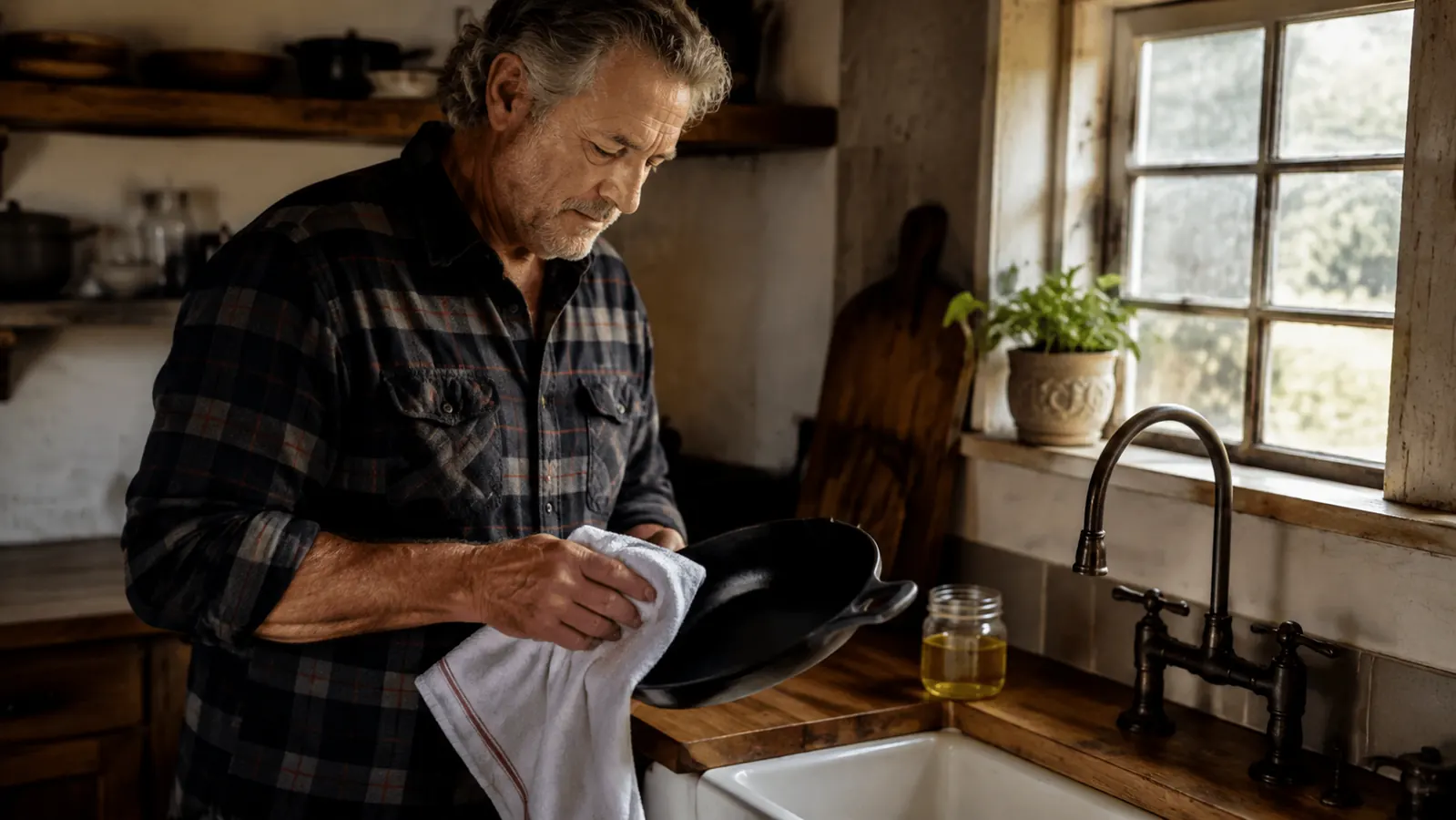
A coated pan that is ruined is garbage, and that is the whole disposal cycle in one sentence. Cast iron is different. Scrape off a rust spot with steel wool, wash it, oil it, put it in a warm oven for an hour, and it is back in service. Stripped the seasoning down to bare iron somehow? Same fix, just an afternoon of it. You would have to crack the thing to actually kill it.
The Cost Per Year of Service Beats Everything Else
Here is the arithmetic that finally got through to me. At today's price, the 12-inch Lodge runs about the same as a decent large nonstick pan. That nonstick gives you two or three years before the coating goes. The Lodge gives you decades, plural, and the re-seasoning costs a tablespoon of oil. Buy one and you stop buying pans, which is the only reason this article exists.
It Is a Pan You Can Actually Inherit
My father in law's skillet came from his mother, and it was already old when it came to him. There is a whole class of cast iron from the 1930s and 40s still in daily use, and you cannot say that about any nonstick or aluminum pan ever made. Buy a Lodge now and it is a reasonable thing to leave to your own kid. There are very few purchases in a kitchen that work out that way.
The Care Routine Is Three Minutes Once You Know It
People treat cast iron like it is high maintenance, and the truth is the opposite. Hot water, a scrape with the spatula, a wipe, back on the burner until the water is gone, a teaspoon of oil. That is the whole routine, and it is shorter than loading a coated pan into the dishwasher and hearing it rattle around in there. After a couple of weeks it is reflex and you stop thinking about it entirely.
It Is Oil and Iron, Nothing Else in the Pan
Lodge makes the pan from iron and the seasoning from vegetable oil, and that is the entire ingredient list. No PFOA, no PFAS, no coating chemistry that starts breaking down when you crank the heat for a hard sear. If you are old enough to remember when nonstick meant a hot pan and butter, you know exactly what this is. It is the honest version of a frying pan, and it does not expire.
Who Should Skip This Pan
Honest version. If you have wrist or shoulder trouble, five and a half pounds is a real lift every time you go from stovetop to sink, and there is no shame in that being a dealbreaker. If you refuse to hand wash anything, this pan will not survive your dishwasher, and I am not going to pretend otherwise. And if you only cook delicate eggs and never sear anything, a good coated pan is honestly easier day to day. This pan is for people who want one durable workhorse and are willing to spend three minutes a day on it. That is the trade, and it is a fair one.
A skillet from the 1930s still cooking dinner every week is the only proof you need that this design does not wear out. It just accumulates cooks.
Stop Buying Pans. Buy the Last One.
The 12-inch Lodge is the pan my family has been handing down, and for the money it is the best value in my kitchen. Check the current price and start one of your own.
Amazon Check Today's Price on Amazon →